Our Vision
Press Release
For Immediate Release
May 17, 2024 (Portsmouth, VA) In recognition of the May 21st
– 23rd 1861 Contraband Escape,
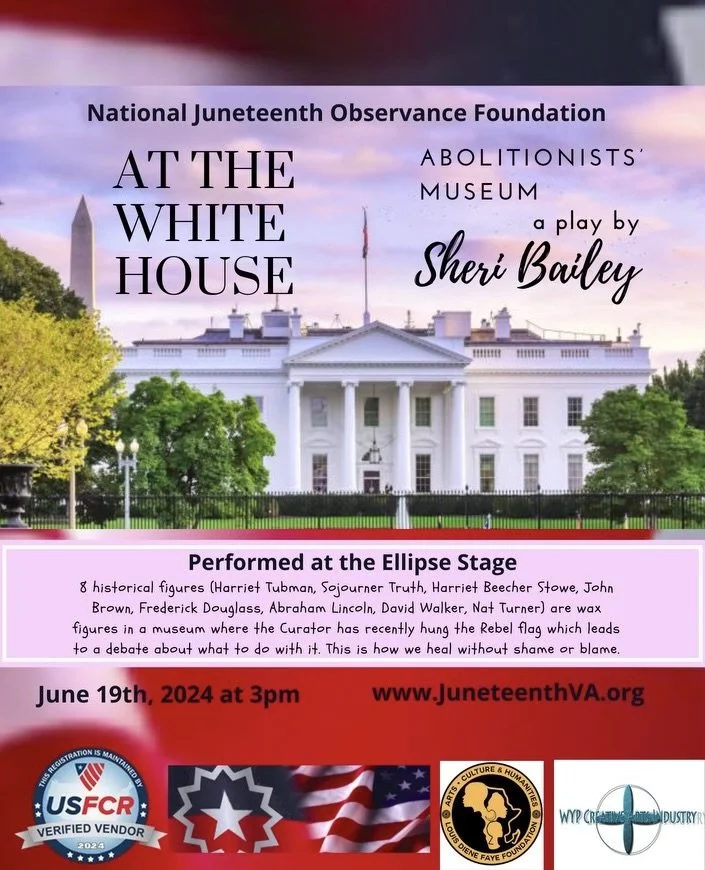
Abolitionists' Museum a play written and directed by Sheri Bailey will be presented by the National Juneteenth
Observance Foundation at the White House on the Ellipse Stage at 3pm, Wednesday, June 19th
. Under the
umbrella of Ms. Bailey’s production company SB, Ink, a film adaptation of Abolitionists’ Museum with
producer and actor Michael LeMelle is forthcoming. Using the following tools JuneteenthVA seeks to educate
and entertain without shame or blame. Thank you for giving your valued time to review this material.
Abolitionists' Museum
The play features Harriet Tubman, Harriet Beecher-Stowe, Sojourner Truth, Nat Turner, John Brown, Frederick
Douglass, David Walker, and Abraham Lincoln. These eight are wax figures living in a museum where the
curator has recently hung a Confederate flag. Using their actual words from speeches and writings mixed with
contemporary references, the characters debate and then vote on whether to burn the rebel cloth. In the post-
show the audience is asked, "Would you vote yes or no to burn the Confederate flag?"
Fort Monroe Think Tank Considers Race and the Development of Anti-Racist Policies
Fort Monroe's significance in American history cannot be overstated. This is where in the latter part of August
1619, "20 and odd" kidnapped Angolan men and women came to the end of a forced ocean journey. Some of
this group found themselves in Jamestown as indentured servants who learned skills and ultimately earned their
freedom. Think of them as the ancestors of today's Black middle-class.
Contraband Escape: The Greatest Moment in American History
Fast forward 242 years when three enslaved men Shepard Mallory, Frank Baker and James Townsend escaped
from their owner in Norfolk. They found their way to the Union camp in Hampton and made their freedom
appeal. On May 23, 1861, Union General Benjamin Franklin Butler having refused to return the men to their
former owner put Baker, Mallory and Townsend on the federal payroll which put them on the path to
citizenship. This is the moment chattel slavery first begin to end in America. Throngs and scores of people,
young and old, man and woman, boys and girls streamed into "Freedom Fortress Monroe." In May 2020
noted Civil War historian Edward Ayers responded with the following to JuneteenthVA's request for support of
our “important work” to build a 21st century Fort Monroe-Contraband Camp-Think Tank:
The village that grew up and around Fort Monroe was the product
of the hands and hearts of Black Virginians, people who built new
lives from virtually nothing. The story of the ways that enslaved
people made themselves free, in midst of the Civil War, is one
of the most inspiring episodes in American history, testifying to
the ways that people held in slavery refused to let the bondage
define them. The ways that family, faith, and sheer bravery
sustained them. By helping us to imagine what that last
landscape looked and felt like, to remember the faces and
names of people who pushed into the unknown, to recall the
women and men and children who made new lives for themselves
in the first chance at freedom, the Contraband Village project can
help us confront the challenges of our own crisis. The end of
slavery was the greatest event in the history of the United States
and the contraband story of Fort Monroe played a key role in that
event. We need to do all that we can to remember it.
Edward L. Ayers
Tucker-Boatwright Professor of the Humanities
President Emeritus
University of Richmond
War Against Slavery aka W.A.S. aka WAS: 1831-1877
The War Against Slavery started in 1831 with the Nat Turner Insurrection and "ended" in 1877 with the
withdrawal of Federal troops from the South. This action encouraged the rapid rise of the KKK and Jim Crow.
Other significant events on the WAS timeline include the 1857 Dred Scott U.S. Supreme Court ruling that
essentially said, "Black lives don't matter." The year 1859 brought abolitionist’s John Brown's raid on Harper's
Ferry and that was the spark that ignited the Civil War less than six months later on April 14, 1860, at Fort
Sumter, SC. Less than six weeks later, the Contraband 3 made their bid for freedom and on May 23rd Baker,
Townsend and Mallory were on the path to citizenship. Actions such as theirs tell the stories of the War Against
Slavery aka WAS.
Juneteenth Declaration of Independence
It is 1776 in the 21st century. You, the people are invited to participate in the updating of this document that is
of the people, for the people and by the people.
The Past
Two thousand years ago nobody, save family and the apostles, knew who Jesus was. It was neither a good nor
bad Friday. It was just a regular day when they died on the cross. Then, three days later, they rose from the dead
and word begin to spread that a Jew, a child of God, died on the cross for all of humanities’ sins, for all of
eternity. Christianity went on to be used by the American slaveholders to teach their enslaved people that it was
God’s will that their suffering on earth be rewarded in death with a homecoming celebration into heaven.
The Present
This thought from Ed Ayers’ letter bears repeating.
“
…the Contraband Village project can help us confront the
challenges of our own crisis.” Like the Civil War Trail highway markers, Underground Railroad routes need to
be similarly mapped and identified. JuneteenthVA’s programming challenges stereotypes, engages with
difficult history, and elicits realistic acknowledgement of past harms without shame or blame.
The Future
For over 25 years JuneteenthVA in partnership with various military, educational, municipal, arts, science,
social services, non-profits, small businesses, and corporate entities has created a tool that works. And maybe
someone somewhere else is doing something similar, but only our Tidewater-Hampton Roads region can speak
to America’s birth and first breath.
Historic Diamond: Jamestown, Colonial Williamsburg, Yorktown, and Freedom Fortress Monroe
1607-1877
Contraband Camp
By the war’s end in 1865 over 10,000 people lived at the fort and the surrounding Phoebus neighborhood. In
2024 the region is facing a lack of housing for Navy sailors which is forcing them to sleep in their cars. In the
immediate, M.A.S.H. housing can be setup as plans are drawn to develop a working, functional community that
will house the Fort Monroe think tank and a range of permanent and temporary guests and residents.
Sheri Bailey CEO
.
Heidi Hughes
Event Coordinator
929.278.0101